
Employee Computer Monitoring: Legal Grounds, Boundaries, and Corporate Necessity
With the rapid digitization of the business world and the widespread adoption of hybrid and remote work models, companies have had to reshape their operational oversight and cybersecurity mechanisms. A critical aspect of this transformation is the monitoring of computers and IT systems used in daily business operations.
For employers, enhancing operational efficiency and protecting critical corporate data has become a strict necessity. However, for employees, privacy and data protection remain fundamental rights. So, why is employee computer monitoring necessary, what are its global legal foundations, and where do we draw the line?
Why is Workplace Computer and Activity Tracking Necessary?
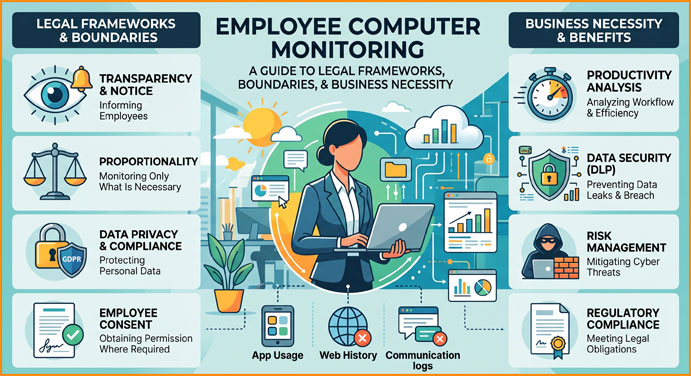
In modern enterprises, tracking employee activities within defined boundaries is not merely a "control mechanism" but a foundational element of corporate sustainability and digital security. Effective monitoring solutions empower businesses in several key areas:
- Protecting Critical Data and Trade Secrets: A company's customer databases, financial records, source codes, and strategic plans are its most valuable assets. Logging system activities is vital to prevent Data Loss Prevention (DLP) and to detect insider cybersecurity threats before they cause irreversible damage.
- Analyzing Workflows and Productivity: Analyzing operational processes during working hours helps identify workflow bottlenecks, unbalanced workloads, and time wastage, ultimately boosting overall organizational efficiency.
- Ensuring Proper Use of IT Resources: It prevents company-provided hardware and software from being used for non-business purposes, such as downloading malware, accessing illegal websites, or consuming excessive network bandwidth.
- Regulatory Compliance: In highly regulated sectors like finance, healthcare, and technology, maintaining event logs of IT systems is often a strict legal requirement to comply with international standards.
The Legal Landscape: Global Frameworks and Foundations
The authority of employers to monitor employee computers is not absolute; it is heavily regulated by different laws depending on the region. When targeting a global market, two main legal philosophies dominate:
The European Approach: GDPR and the Right to Privacy
In the European Union and countries adopting similar models, the General Data Protection Regulation (GDPR) governs monitoring. Under GDPR, monitoring computer activity involves processing personal data. Employers must have a "lawful basis" for tracking. The core principles include:
- Transparency: Employees must be explicitly informed about what is being monitored and why.
- Proportionality and Data Minimization: The tracking must be strictly necessary for the stated purpose. Collecting more data than needed is a violation.
- Human Rights (ECHR): The European Court of Human Rights dictates that even in the workplace, employees have a reasonable expectation of privacy.
The US Approach: ECPA and Employer Property Rights
In the United States, the legal landscape generally leans more toward the employer's rights. The Electronic Communications Privacy Act (ECPA) allows employers to monitor communications if there is a legitimate business reason or if the employee has given consent.
- Because the employer owns the hardware, network, and software, courts often rule that employees have little to no expectation of privacy on company devices.
- However, state laws are becoming stricter. For example, the California Privacy Rights Act (CPRA) requires employers to provide clear notices to employees regarding what data is collected and how it is used.
Core Boundaries and Principles in Employee Tracking
The line between a legal monitoring process and an unlawful invasion of privacy is determined by three universal principles:
- Transparency & Notice Employees must be clearly informed that monitoring is taking place. Mandatory (Secret monitoring is generally illegal, especially in the EU).
- Proportionality The scope of tracking must be proportionate to the legitimate business aim. Mandatory (Do not over-collect data).
- Private Sphere Protection Personal messages, private bank accounts, and personal emails should remain untouched. Mandatory (Strictly monitor traffic/metadata, not private content).
The Ban on Covert Surveillance
Deploying stealth or "spy" software without informing the employee is highly risky. In most global jurisdictions, covert monitoring can lead to severe fines, and any data gathered cannot be used as legal evidence. The scope, purpose, and duration of the monitoring must be communicated in writing.
Traffic Monitoring vs. Content Monitoring
Legally, it is widely accepted for employers to track metadata—such as which websites are visited, application usage times, or idle periods. However, actively reading the contents of a personal email or capturing keystrokes (keylogging) of personal passwords crosses the line of proportionality in many countries.
A Guide to Building a Lawful Monitoring Policy
To ensure your organization’s computer and activity monitoring processes are fully compliant with global laws, follow these essential steps:
- Establish an Acceptable Use Policy (AUP): Create a comprehensive internal policy stating that company computers, email addresses, and internet networks are primarily for business use.
- Draft and Distribute a Privacy Notice: Prepare a document detailing exactly what data is collected (e.g., application logs, screen time, website history) and for what purpose. Require employees to sign or digitally acknowledge this notice.
- Implement Role-Based Access Security: Ensure that collected tracking data is not accessible to everyone. Only authorized HR or IT Security personnel should have access, and the data should be encrypted.
- Define Data Retention Periods: Do not store monitoring logs indefinitely. Establish automated deletion schedules that align with local laws and company policies.
Frequently Asked Questions (FAQ)
Can an employer remotely install monitoring software on a computer?
Yes, provided the employer owns the device and has supplied it for business purposes. However, to remain legally compliant (especially under GDPR), the employee must be informed about the presence of this software beforehand.
Is tracking data valid evidence for termination?
If the data was collected lawfully (with proper notice, proportionate to the business need, and for a legitimate purpose), it is generally considered valid evidence to prove an employee breached corporate policies or leaked company secrets. Illegally obtained data is often dismissed in court.
Can employers monitor via webcams and microphones?
Recording an employee’s physical environment via webcam or microphone, especially continuously or without their knowledge, is widely considered a severe violation of privacy worldwide. This practice is strongly discouraged and is illegal in many jurisdictions.
Conclusion
Employee computer monitoring is an indispensable tool for modern businesses to protect digital assets, ensure cybersecurity, and maximize workforce productivity. However, the success of this process relies heavily on a solid legal foundation built on transparency, clear notice, and proportionality. When companies pair the right technological solutions with transparent corporate policies, they not only mitigate legal risks but also foster a secure, productive, and trust-based work environment.
Start your free trial now.