

Social Media and Gaming Addiction in Children: How Can Parents Control Their Children's Digital World?
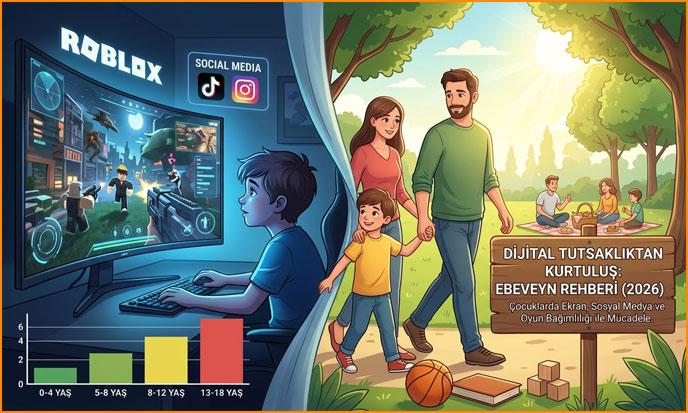
Digital Captivity: Screen, Social Media, and Gaming Addiction in Children as of 2026
Today, one of the biggest struggle areas for parents is those bright screens that never leave their children's hands. Tablets, which entered our lives as a distracting tool in infancy, turn into a social media and gaming marathon lasting for hours during adolescence. So, when did things get out of hand?
By 2026, the current data we have shows that screen addiction has now crossed the boundary of "playing a few hours too much" and has turned into a public health issue directly affecting brain development and psychology. Both global reports and the Turkish Statistical Institute (TÜİK) data clearly reveal the magnitude of the danger.
Let's Face the Numbers: Daily Screen Times by Age
In the interactive table below, you can examine the average daily screen time children and teens spend for out-of-school entertainment according to Common Sense Media's updated 2026 counts.

A Striking Fact: %40 of 2-year-olds have their own tablet and are regularly in front of a screen every day.
Detailed Age Breakdowns and Addiction Trends
- 0-4 Years (The Tablet Era): Average 1-2 hours. The American Academy of Pediatrics (AAP) recommends zero screen time for children under 18 months, except for video chatting. Despite this, a large majority of babies are introduced to screens far beyond this rule. Experts state that excessive screen time at this age leads to permanent delays in language and social development.
- 5-8 Years (The Rise of Short Videos): Average 3.5 hours. The biggest danger in this group is games and short-form videos like TikTok/YouTube Shorts. Such content has been watched 14 times more by children since 2020. As a result, attention spans are steadily narrowing.
- 8-12 Years (Gaming and YouTube Domination): Average 5.5 hours. Games like Roblox and Minecraft, along with YouTube, consume 65% of this age group's time.
- 13-18 Years (The Social Media Peak): Average 8 hours and 39 minutes! This duration is more than a full-time job. More than half of teens experience an anxiety condition called "nomophobia" when separated from their phones for just 30 minutes.

Turkey Report: What Are Our Children Giving Up?
Global data aside, the picture in Turkey is also quite alarming. According to the Ministry of Health data, the daily screen time for children aged 6-13 in Turkey is exactly 6.4 hours. TÜİK's 2024 Research on Information Technology Usage in Children reveals how the attachment of children (aged 6-15) to devices erodes their social lives.
What activities are our children abandoning the most because of screen time?
Furthermore, TÜİK research shows that 32.6% of children feel the need to check their phones every half hour. In the gaming world, a gender divide draws attention; the rate of playing digital games is significantly higher among boys than girls.
The Cost of Addiction: Why Should We Be Concerned?
Screen and social media addiction is not just a "time management" issue. As of 2026, scientists firmly warn parents about the following:
- Brain Structure (White Matter): Excessive screen exposure in infancy can lead to premature/abnormal maturation in brain networks responsible for visual processing and cognitive control.
- Sleep Quality: Beyond blue light, the fast pace and psychological arousal in games or TikTok-like algorithms keep the nervous system active, making it difficult to fall asleep.
- Attention Deficit and Anxiety: Symptoms of anxiety and depression are seen twice as often, especially in teenagers with 4 hours or more of screen time compared to others.
A Solution Roadmap for Parents
The American Academy of Pediatrics' updated 2026 approach suggests parents focus on the quality and context of content rather than strict time limits:
- Be a Content Police: Not everything is "educational" for kids under 5. Co-view with your children and turn passive viewing into a shared experience.
- Draw the Line Against Short Videos: Algorithm-driven short video loops like TikTok or Shorts directly undermine young children's attention skills. Opt for content that has a distinct beginning and end whenever possible.
- Be a Role Model: The basic rules in the house are set by the parents. Children closely observe how addicted adults are to their phones.
Screens won't disappear from our lives, but it is in our hands to stop them from being a child's babysitter or best friend.
More control in digital parenting
Parents who want to manage their child's digital device usage more systematically can learn about Bosseye's child-focused digital safety and parental control solutions. Learn about Bosseye
Other Articles: